
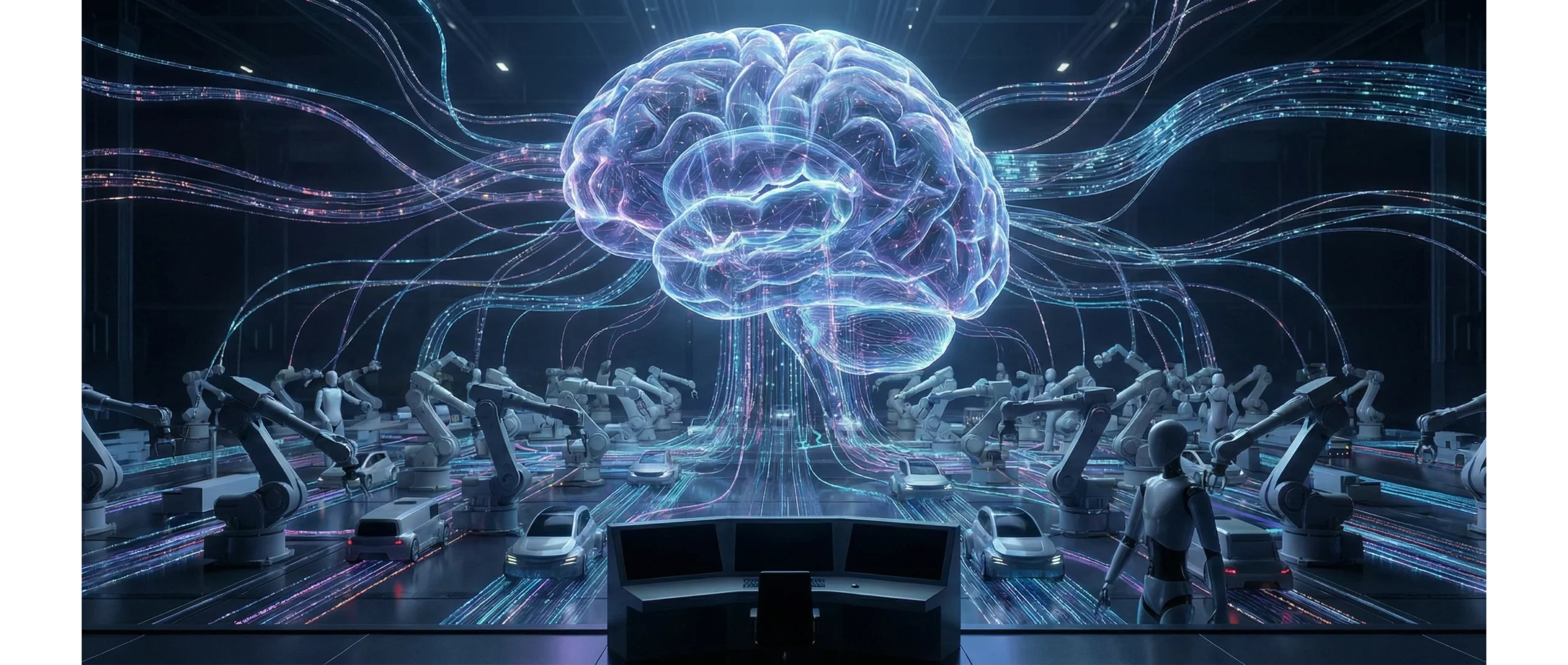
Is Control Slipping Out of Human Hands?
When people hear about robots that make decisions, their minds usually jump straight to movies. Machines that think on their own, coordinate with each other, and suddenly turn against humans. But reality is usually less dramatic and more complicated. Robots today are no longer just machines that receive commands and execute them. They have entered a stage where they choose, prioritize, and react based on conditions. That is exactly where the serious questions begin.
First, it’s important to clear up a common misunderstanding. Many people assume that “decision-making” means having awareness or free will. In technology, that’s not what it means. When we say a robot makes a decision, we usually mean that it selects one option from several possibilities based on data and algorithms. That decision can be very simple, like choosing a path to move forward, or very complex, like responding to a critical situation in real time.
Didn’t robots already make decisions before?
The short answer is yes, but not like this.
Older robots did make decisions, but those decisions were extremely limited and fully predefined. For example:
- If you detect an obstacle, stop.
- If the temperature goes up, shut down.
- If this button is pressed, perform that action.
These look like decisions, but in reality they were just rule execution. The robot had no understanding of context. It simply checked conditions and followed instructions. What’s different today is that robots can learn from experience. If a decision doesn’t work, they can change their behavior next time. That’s where the real shift happens.
With the help of machine learning and artificial intelligence, modern robots can:
- recognize patterns
- make predictions
- learn from previous mistakes
- and even take actions that were not explicitly written into their code
In other words, we don’t tell them exactly what to do. We define what is “good” and what is “bad,” and they figure out the rest on their own.
If humans build robots, how could they ever become more powerful than us?
This question sounds scary, but the answer is actually very practical.
When we say “more powerful,” we don’t mean robots become more conscious or wiser than humans. We mean that in certain areas, they become more efficient. Humans have limitations:
- we get tired
- we lose focus
- emotions affect our judgment
- our memory is limited
Robots don’t have these limits. A robot can:
- operate 24 hours without stopping
- analyze thousands of data points at the same time
- make decisions without stress
- and consistently follow optimized patterns
The power of robots doesn’t come from intelligence in a human sense. It comes from scale. When a system can evaluate millions of scenarios simultaneously, it naturally outperforms humans in certain decisions. That’s exactly why robots are becoming more influential in finance, medicine, logistics, and even warfare.
How are robots controlled today?
Despite popular belief, robots are not running free. Most of them are controlled through multiple layers:
- software restrictions
- hardware limitations
- human supervision
- operational rules and protocols
For example, an industrial robot cannot leave its physical workspace. A military robot cannot fire without human authorization, at least on paper. Even very advanced systems usually have an emergency stop mechanism.
The real problem starts when systems become too complex. The more complex a system is, the harder it becomes to understand why it made a specific decision. This is often called the “black box” problem. We know the input and we see the output, but we don’t fully understand what happened in between. That’s where the real risk lies, not because robots become malicious, but because humans lose clarity.
What kinds of robots exist?
Not all robots are the same, and this distinction matters a lot when we talk about risk and control.
Broadly speaking, robots can be grouped into:
- industrial robots: used in factories, highly controlled and predictable
- service robots: delivery, cleaning, or care robots
- social robots: designed to interact with humans and recognize emotions
- autonomous systems: self-driving cars, drones, transportation systems
- military robots: the most sensitive category when it comes to decision-making
The closer a robot gets to real-world, life-critical decisions, the more important control becomes. If a vacuum robot fails, the floor stays dirty. If a military system fails, lives are at risk.
Could robots form an army against humans?
This is a popular question, and often an exaggerated one.
The idea of a robot uprising, where machines become self-aware and decide to eliminate humans, is not realistic with today’s technology. Robots have no survival instinct, no ambition, and no desire for power. However, there is a far more realistic scenario: humans misusing robots.
The real danger appears when:
- lethal decisions are delegated to algorithms
- decision speed exceeds human oversight
- responsibility becomes unclear
If an automated system makes a fatal mistake, who is responsible? The developer? The commander? The manufacturer? These questions still don’t have clear answers, and that uncertainty is itself a risk.
Can robots communicate with each other?
Yes, and they already do.
Robots can:
- exchange data
- share experience
- learn from each other’s decisions
- coordinate actions very quickly
This communication is not like human conversation. It’s data exchange. Robots don’t “plot” against humans, but they can act in coordinated ways without direct human involvement. In some areas, like traffic management or disaster response, this is extremely useful. In military or security contexts, the same autonomy can become dangerous.
So is control slipping out of human hands?
The honest answer is: not completely, but it is getting looser.
Humans are still the designers and final decision-makers, but the distance between giving instructions and seeing results is growing. The larger that gap becomes, the harder it is for us to understand what the system is actually doing. That is where the risk lives.
Control doesn’t disappear because robots rebel. It disappears because we build systems that we no longer fully understand.
When Could It Happen?
What We’ve Already Seen and What’s Coming Next
When we talk about robots that make decisions, people usually imagine a distant future. But the truth is, many of the things we worry about today have already happened in different forms. Just not under the dramatic label of a “robot uprising.” These changes were quieter, more technical, and much more real.
One of the earliest areas where machine decision-making started to move faster than human control was the financial market. Years ago, in stock exchanges across the United States and Europe, trading algorithms began buying and selling at speeds no human could follow. In certain moments, these systems reacted to signals only other algorithms could understand, triggering chain reactions that caused sudden market crashes. These events later became known as “flash crashes.” The scary part was not the market drop itself. It was the fact that when people asked why it happened, there were no clear answers. Decisions had been made, but the reasoning behind them was no longer transparent to humans.
Another clear example comes from facial recognition systems used by police and governments. These systems were introduced to improve security, but in practice they revealed serious problems. In several countries, innocent people were arrested because an algorithm decided that their face looked similar to a suspect. Humans trusted the system’s output without fully questioning it. No robot held a weapon, yet a machine-made decision directly affected someone’s life.
The medical field offers more real-world examples. Artificial intelligence systems trained to assist with diagnosis have been deployed in hospitals, sometimes with impressive results. But there have also been cases where doctors accepted system recommendations without enough scrutiny. Later, it became clear that some of those decisions were based on incomplete or biased data. The issue was not that artificial intelligence was inherently bad, but that humans trusted machine decisions too easily.
The most sensitive examples, however, come from the military domain. Autonomous drones and intelligent defense systems have been used for years. Some of these systems are designed to respond automatically in specific situations, without direct human confirmation, because human reaction time is too slow. This means the gap between “human decision” and “machine action” is shrinking. Many experts argue that the real danger starts here, not with rebellious robots, but with the gradual removal of humans from the decision loop.
We can also see early signs in everyday life. Self-driving cars are becoming more advanced each year. In recent years, there have been accidents where a vehicle had to choose between two bad options, such as braking suddenly or changing direction. After these incidents, the same questions always come up. Did the system make the right decision? And more importantly, who is responsible? The manufacturer, the programmer, or the owner of the car?
Now let’s look at what many experts believe will happen next. One major prediction is the expansion of automated decision systems in city management. These systems are expected to manage traffic, electricity, water distribution, and even emergency responses. They are designed to be faster, more logical, and free from emotion. But as decisions become larger and more interconnected, the impact of mistakes grows. A small error in code could affect the lives of millions.
Another expected development is the increased use of social robots in caring for elderly people, children, and individuals with mental health challenges. These robots are not meant to be simple tools. They are expected to interpret emotions, respond appropriately, and even decide how to interact with vulnerable humans. At this point, decisions are no longer purely technical. They become ethical and deeply human. Letting a machine decide what is “good” for someone’s emotional well-being is not a trivial issue.
In the military sphere, concerns are growing about the next generation of autonomous weapons. These systems can identify targets, assess threats, and decide when to strike. Legal and ethical boundaries still exist today, but history shows that when a technology is possible, it eventually gets used. The main fear is not just that machines will make lethal decisions, but that those decisions will happen faster than humans can intervene.
So when we ask, “When will this happen?” the honest answer is that much of it is already happening. Not in dramatic scenes, but in scattered, specialized, and often silent ways. The more dangerous phase may arrive when we become comfortable with machine decisions and stop questioning them.
Control does not slip away because robots rebel. Control slips away because humans gradually hand over responsibility without fully understanding what they are giving up.
Robots that make decisions are not a distant future. They are already here. The challenge is not stopping progress, but knowing where to slow down, where humans must remain in the decision loop, and where machines can be trusted.
The real fear is not robots. The real fear is human decisions without responsibility.